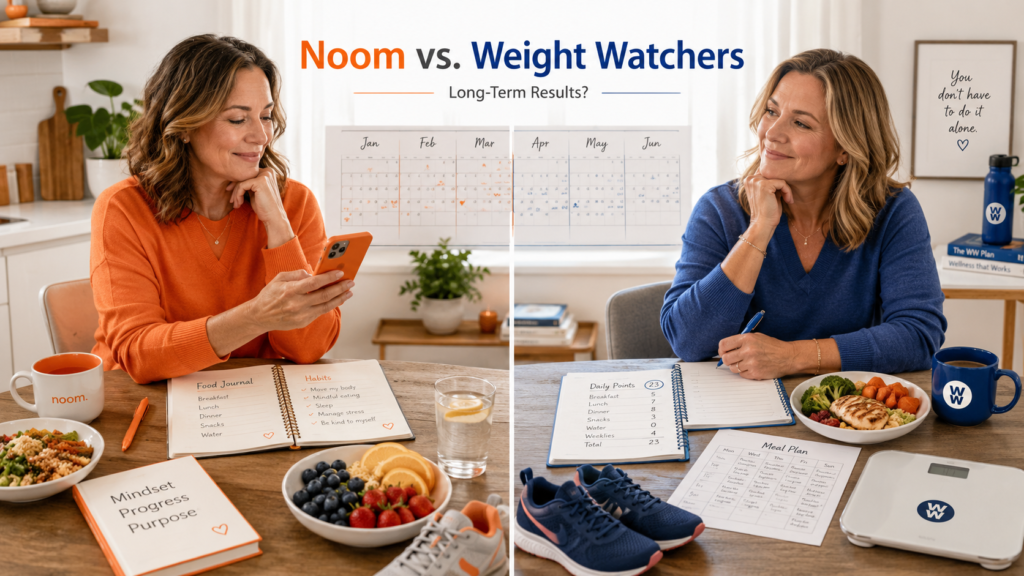

One program costs $209 a year and teaches you why you overeat. The other costs $4,800 and ships you prepackaged meals. Both produce weight loss, but here’s what happens when you stop: research shows up to 50% of lost weight returns within a year on meal replacement plans.
Key Takeaways
- Noom uses Cognitive Behavioral Therapy (CBT) to build lasting habits around real food, while Optavia relies on structured meal replacements to control what you eat.
- Optavia can deliver faster initial weight loss, but research shows meal replacement programs carry a high risk of weight regain once the structured products stop.
- Noom costs roughly $209/year on an annual plan; Optavia can exceed $4,800/year when Fuelings and grocery costs are combined.
- The coaching models are fundamentally different – and that gap matters more than most people realize before signing up.
- For those focused on long-term maintenance rather than rapid loss, the methodology behind a program matters far more than the number on the scale at week four.
Choosing between Noom and Optavia is not just about picking a diet – it is about choosing a philosophy. One program hands you a psychological toolkit and trusts you to use it. The other hands you a box of prepackaged meals and a rigid daily plan. Both can produce results, but they produce very different kinds of results, for very different people, at very different costs.
Two Completely Different Theories of Weight Loss
At the core, these two programs disagree on a fundamental question: Why do people struggle with weight? Noom’s answer is that the mind is the problem – and therefore the solution. Optavia’s answer is that the environment is the problem – remove the decisions, and the weight comes off.
That distinction shapes everything: what you eat, how you are coached, what happens after you stop, and how much you pay. Weight Loss Mindset breaks down both sides of this debate so readers can make a genuinely informed decision rather than one driven by marketing.
How Each Program Actually Works
Noom: CBT, Color-Coded Logging, and Habit Loops
Noom operates as a psychology-driven mobile app. Its foundation is Cognitive Behavioral Therapy (CBT) – a clinically recognized approach that works by identifying the thoughts and emotions that drive eating behavior, then replacing unproductive patterns with healthier ones. Academic reviews recognize CBT as a preferred psychological intervention for obesity, particularly from a long-term perspective, though it does not always directly produce significant weight loss on its own.
In practice, Noom’s daily experience involves three core activities:
- Color-coded food logging – foods are categorized green, yellow, or red based on calorie density, not arbitrary bans. Pizza is not forbidden; it is logged in context.
- Daily lessons and quizzes – short, article-style content covering mindset, habit formation, emotional eating, and nutritional literacy.
- Virtual coaching via chat – personalized check-ins focused on behavior and psychology, not calorie math.
The program integrates elements of Acceptance and Commitment Therapy (ACT) and mindfulness-based stress reduction (MBSR) alongside CBT. A systematic review found that Noom users lost approximately 5% of their initial body weight over 16 weeks, and 56% of users achieved at least 5% body weight loss after six months. You use your own groceries throughout – no delivery, no proprietary products.
Optavia: The 5&1 Plan, Fuelings, and Structured Simplicity
Optavia operates on a completely different premise: reduce decision fatigue to near zero. The flagship 5&1 Plan means five prepackaged Fuelings per day – bars, shakes, soups, and similar processed items – plus one homemade Lean & Green meal of lean protein and non-starchy vegetables. Five out of six daily meals are Fuelings, making branded products the dominant source of daily calories. Total daily intake lands between 800-1,000 calories, placing it firmly in the very low-calorie diet category by clinical standards.
There is no food logging, and the plan places little emphasis on developing nutritional reasoning – just compliance with the structure. For people who are overwhelmed by choices and want meals essentially pre-decided, that structure has genuine appeal. The same structure, though, creates a dependency that becomes a liability the moment the Fuelings stop.
Coaching Quality: Who’s Really Guiding You?
Noom: Health Coaches Focused on Psychology and Behavior Change
Noom’s coaching is delivered virtually through the app. Coaches focus on mindset work – helping users work through emotional eating triggers, reframe setbacks, and stay consistent with daily habits. While Noom’s coaches are not uniformly licensed dietitians or clinical psychologists, the emphasis on CBT tools and daily structured lessons means the system itself does much of the behavioral scaffolding. The coaching reinforces it.
Optavia: Independent Distributors, Not Healthcare Professionals
Optavia’s personal coaches are typically former program participants or affiliates. They are not required to hold any nutrition or healthcare license. Support comes via text, phone calls, and community forums. For general accountability and motivation, this model can work. For anyone with complex health needs, metabolic conditions, or a history of disordered eating, the absence of clinical expertise is a meaningful concern that dietitians have repeatedly flagged in reviews of the program.
Speed vs. Staying Power: What the Evidence Shows
Noom’s Documented Results
A peer-reviewed observational study found Noom users lost an average of approximately 8% of body weight over nine months when engaging actively with the program and coaching. A separate clinical trial published on PubMed found CBT was effective for weight maintenance over a 24-week period in women who had already lost weight – helping them sustain reduced calorie intake and increased physical activity. These are not blockbuster numbers, but they represent durable, real-world outcomes from a skill-based approach.
Optavia’s Rapid Loss – and Its Limits
Optavia’s marketing prominently features claims of significant early weight loss. The company states that the 5&1 Plan can help clients lose an average of 12 pounds over 12 weeks. Research does confirm that meal replacement programs can produce roughly twice the short-term weight loss of traditional reduced-calorie diets over three months. The gap is what happens next. These figures come from internal data and testimonials rather than independent randomized controlled trials, and long-term maintenance data after stopping Fuelings is limited in the published literature.
The Weight Regain Problem After Stopping
Why Meal Replacements Create a Transition Gap
University extension research on meal replacement diets found that up to 40-50% of lost weight is regained within one year of stopping. The reason is structural: when the prepackaged meals disappear, so does the system that was doing all the decision-making. Users are left rebuilding an eating pattern from scratch, without having developed the nutritional literacy or psychological skills to do it confidently. Dietitians consistently point to this transition gap as Optavia’s most significant long-term limitation.
Why Skill-Based Programs Protect Long-Term Maintenance
Noom’s design sidesteps this problem because the skills – logging, CBT tools, mindful awareness of calorie density – are transferable to any food environment. Research on long-term weight maintainers consistently identifies regular self-monitoring as one of the strongest predictors of staying at a lower weight. Noom builds that habit directly into the daily experience, fostering lasting behavioral changes and skills that users can apply beyond the subscription period. The program is designed for ongoing, indefinite use, not a finite phase.
Cost Breakdown: ~$209/Year vs. $4,800+/Year
The financial gap between these programs is significant – and it compounds over time.
Noom: Annual Plan vs. Monthly Subscription Costs
- Monthly: approximately $70/month on the auto-renewing plan
- Annual plan: approximately $209/year on the auto-renewing annual plan
- Additional food costs: whatever you would normally spend on groceries – no required add-ons
Optavia’s cost structure is considerably heavier:
- Starter kit (first month): $395-$450+ for the Essential Optimal Kit on the 5&1 Plan
- Ongoing monthly Fuelings: $400-$500+ depending on plan and replenishment frequency
- Lean & Green grocery costs: approximately $100/month additional for homemade meals
- Annual total: can exceed $4,800/year for someone staying on the full 5&1 plan
That is not a marginal difference. Over two years, the gap between programs can exceed $9,000. High cost also creates a specific behavioral risk: when budgets shift or plan fatigue sets in, users often abandon Optavia entirely – arriving at the transition gap with no behavioral foundation and no financial runway to seek alternatives.
For Lasting Results, the Methodology Matters More Than the Scale
Both Noom and Optavia can produce real weight loss. The more important question is: what are you building while the weight comes off? Optavia builds compliance with a system. Noom builds skills that outlast the program itself.
For people who need rapid, highly structured loss, have the budget, and plan to transition deliberately into a behavioral program afterward, Optavia has a role. As a standalone long-term strategy, its dependency on proprietary products and unlicensed coaching creates significant fragility.
For those focused on sustainable behavior change – understanding why they eat the way they do, developing real-food skills, and maintaining results without a monthly product subscription – the evidence consistently points toward the CBT-based approach. The methodology matters more than the month-one number on the scale.
For deeper guidance on building a weight loss mindset that actually sticks, visit Weight Loss Mindset for ongoing insights into the psychology and habits behind lasting change.