
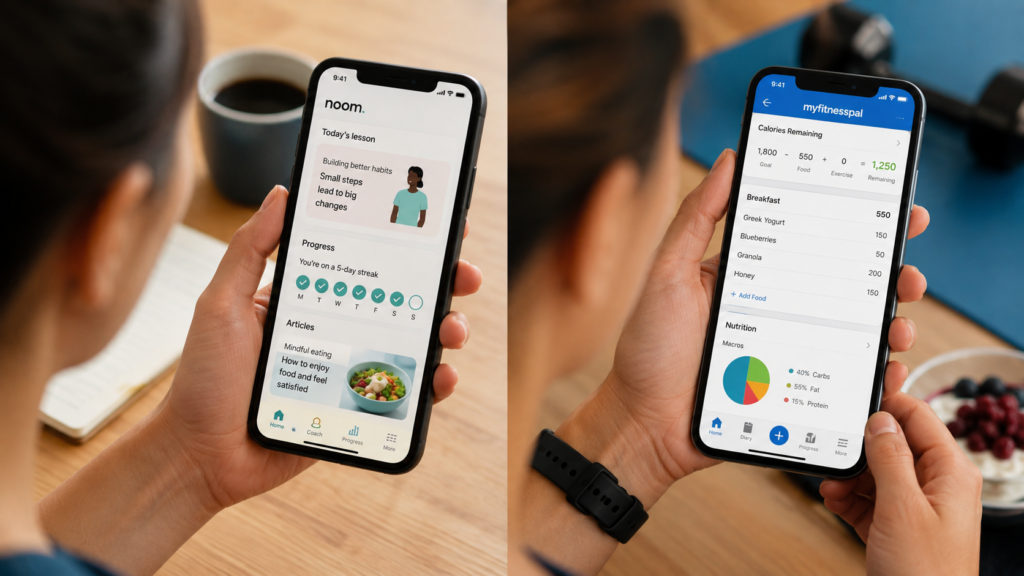
Before you download another weight-loss app, know this: Noom paid $62 million to settle claims about deceptive auto-renewals, and MyFitnessPal’s crowdsourced food database has documented accuracy problems that peer-reviewed studies flag as serious. Here’s what the actual research shows about both.
Key Takeaways
- Noom is built around behavior-change psychology – using CBT, ACT, and DBT – while MyFitnessPal is a data-first tracking tool that leaves the mental side of eating to the user.
- Independent research finds both apps deliver modest weight-loss results, and Noom’s most favorable studies are largely company-funded with self-reported data.
- MyFitnessPal’s crowdsourced food database has documented accuracy problems, with peer-reviewed studies flagging significant error rates in popular entries.
- Both apps carry real risks for people with a history of disordered eating – a nuance that rarely appears in marketing copy but matters a great deal in practice.
- Choosing between the two comes down to one question: do you need a coach to change your mindset, or a dashboard to manage your data? That answer shapes everything else covered below.
Weight loss apps are not all chasing the same goal. Noom and MyFitnessPal are two of the most downloaded options in the category – but they are engineered for completely different users. Understanding that difference up front saves wasted money and frustration.
Two Apps Built for Completely Different Jobs
At the simplest level: Noom is a behavior-change program that happens to include food logging. MyFitnessPal is a calorie and macro tracker that happens to include some community features. Neither is wrong – they solve different problems. Choosing one over the other is really choosing between “coach me to think differently about food” and “give me the numbers and let me figure it out.”
For anyone interested in the psychology behind sustainable weight loss – why habits form, why they break, and what makes change stick – Weight Loss Mindset covers exactly that territory in practical, readable terms. Worth a look before committing to either app.
Noom’s Psychology-First Engine
Noom’s core argument is that most people don’t fail at weight loss because they lack nutrition information. They fail because of behavioral patterns – emotional eating, all-or-nothing thinking, stress responses to food. The app is designed to address those patterns directly, rather than just counting calories.
CBT, ACT, and DBT in a Daily App
Per Noom’s own 2026 randomized controlled trial description, the program integrates behavior-change techniques drawn from cognitive behavioral therapy (CBT), acceptance and commitment therapy (ACT), and dialectical behavior therapy (DBT). These aren’t buzzwords attached to a calorie counter – they shape the daily lesson structure, the coaching prompts, and the way the app frames setbacks.
CBT helps users identify psychological triggers and reframe self-defeating thoughts. ACT focuses on values-based behavior rather than rigid food rules. DBT contributes emotional regulation tools. Together, they form a curriculum that addresses why someone eats the way they do, not just what they eat.
The catch: at a price of $59-70 per month on a month-to-month basis, the value proposition weakens once the curriculum content starts repeating and the app effectively becomes a food logger.
Noom’s Hybrid Support Model: Human Coaches, Groups, and AI
Noom pairs its daily lessons with one-on-one human coaching and group support – a structure that sets it apart from pure-tracking competitors. The coaching model relies on behavior-change specialists rather than certified dietitians or registered nutritionists, which matters if clinical nutrition guidance is the priority.
User feedback is mixed. Some find the accountability genuinely useful. Others describe coaching interactions as impersonal, with coaches defaulting to scripted questions rather than real dialogue. Noom has also introduced Welli, an AI assistant for food logging, and Noom Vibe, a habit-tracking and wellness community companion app – signaling a clear shift toward AI-augmented support.
MyFitnessPal’s Tracking-First Strengths
MyFitnessPal’s design centers on data, not guidance. The app tracks food intake, macros, and calories with precision – but stops short of coaching users on what to do with that information. For self-directed users who want data and nothing else, that restraint is a feature, not a flaw. It is worth noting that MyFitnessPal has added an AI Nutrition Coach for personalized guidance and a GLP-1 journey support tool for medication tracking, so some coaching-adjacent features do now exist – though behavior-change psychology remains outside its core design.
One of the Largest Food Databases, Widest Integrations
MyFitnessPal’s genuine strength is its infrastructure. It carries one of the largest food databases in the category and connects to 50-plus fitness devices and apps – Apple Watch, Fitbit, Garmin, Strava, and more. For macro tracking, calorie totals, and wearable sync in one place, few consumer apps match it on raw functionality. Recent additions include AI-powered Meal Scan (live camera food recognition), Voice Log, and a Photo Upload feature for Premium users – a direct response to a wave of AI-first nutrition apps.
The Crowdsourced Accuracy Problem
The database’s biggest weakness follows directly from its biggest strength: the data is crowdsourced. Peer-reviewed validation studies consistently flag significant error rates in user-submitted entries. Research has found that crowdsourced nutrition databases can carry energy errors exceeding 20% across a meaningful share of popular entries, with some entries deviating substantially from lab-verified values. Researchers have cautioned against stand-alone reliance on MyFitnessPal for accurate dietary tracking. Packaged foods scanned via barcode are generally reliable – manual entries, restaurant meals, and home recipes are where the numbers go sideways.
What the Evidence Actually Shows
Neither app has a bulletproof evidence base. The honest picture is more nuanced than either company’s marketing suggests.
Noom’s Company-Funded Research
Noom does maintain an active research program, which is more than most apps can claim. Its flagship 2026 RCT (McCallum et al., Obesity Science and Practice, n=427) showed Noom users lost an average of 4.1% of body weight at 68 weeks, compared to a 1.5% gain in the control group – a statistically significant result. Earlier observational work (Chin et al., Scientific Reports, 2016) found 77.9% of 35,921 users reported weight loss, though with no control group and entirely self-reported data.
The problem across Noom’s studies: they are largely authored and funded by Noom, the 2026 RCT relied on self-reported weights, and the sample was 83% female. McMaster physician Dr. Hasan Merali noted in an NBC News commentary that positive Noom studies “were funded by the company itself,” cautioning that “Noom has not yet proven it can make this challenge any easier over the long run.”
Independent Studies: Modest Effects Across the Board
Broader independent research paints a sobering picture for the entire app category. A 2022 meta-analysis published in JMIR found smartphone-based weight-loss apps produced only small losses that tapered over twelve months – effects the authors described as minimal. A Cochrane review similarly rated the overall evidence for weight-loss apps as low-certainty. CBT-based digital interventions show a modest weight-loss advantage in meta-analyses, but are recommended as adjunctive tools, not primary treatments. MyFitnessPal, for its part, has essentially no efficacy-trial evidence for itself as a weight-loss intervention – its research footprint is dominated by database-accuracy studies.
Cost, Paywalls, and Consumer Complaints
Pricing is where both apps have frustrated users, though in different ways. Noom runs approximately $59-70 per month on a month-to-month basis, dropping to around $17 per month on an annual commitment. MyFitnessPal offers a free tier, but it has been significantly stripped back – the barcode scanner moved behind the Premium paywall in 2022, and free users are now capped at five food entries per day, changes that provoked sharp user backlash.
Noom’s $62M Settlement and Cancellation Friction
Noom’s consumer-protection history is worth knowing before subscribing. In 2022, Noom paid $62 million ($56M cash, $6M in subscription credits) to settle a class action lawsuit – Mahood v. Noom – alleging that the company trapped roughly two million users through deceptive “risk-free” trial auto-enrollments and deliberately difficult cancellation flows. The settlement required Noom to implement explicit auto-renewal consent, easier cancellation, and reminder emails. This is a consumer-protection flag that shouldn’t be ignored when handing over payment details.
Shared Risks: Disordered Eating Concerns
Both apps draw criticism from dietitians and eating-disorder clinicians – and the concern is legitimate enough to state plainly. Noom’s traffic-light food color system, while framed as a calorie-density guide, can still imply moral food categories in a way that risks fostering an unhealthy relationship with food. Calorie tracking apps more broadly have been linked in peer-reviewed research to disordered-eating symptoms, including food preoccupation, all-or-none thinking, and food anxiety – particularly among users tracking for weight or appearance reasons. Both apps are widely considered inappropriate for anyone with an active or past eating disorder.
Psychology Coach or Data Dashboard – Pick the Right Tool
The choice between Noom and MyFitnessPal is ultimately a question of what kind of support fits the situation.
- Choose Noom if emotional or stress eating is the core struggle, a structured curriculum with human accountability sounds useful, and the cost of the annual plan (around $17 per month) is manageable. If lessons start repeating, that’s a signal to extract what’s been learned and move to a cheaper tracker.
- Choose MyFitnessPal if the goal is reliable calorie and macro data, wearable device integration matters, and self-direction is the preferred mode. Budget users should anticipate that the five-entry cap and barcode paywall will likely push toward the Premium tier ($79.99 per year) fairly quickly.
- Choose neither if there’s any history of disordered eating – professional support is the right move there – or if nutritional accuracy is the top priority (Cronometer, which uses verified USDA/NCCDB data, is the stronger pick in that case).
These are genuinely different tools solving genuinely different problems. The honest question to ask isn’t “which app is better” – it’s “which problem am I actually trying to solve?”
For a deeper look at the mindset work that makes weight-loss habits stick long after any app subscription ends, Weight Loss Mindset covers the behavioral and psychological foundations that both apps are – in their own ways – trying to build on.