
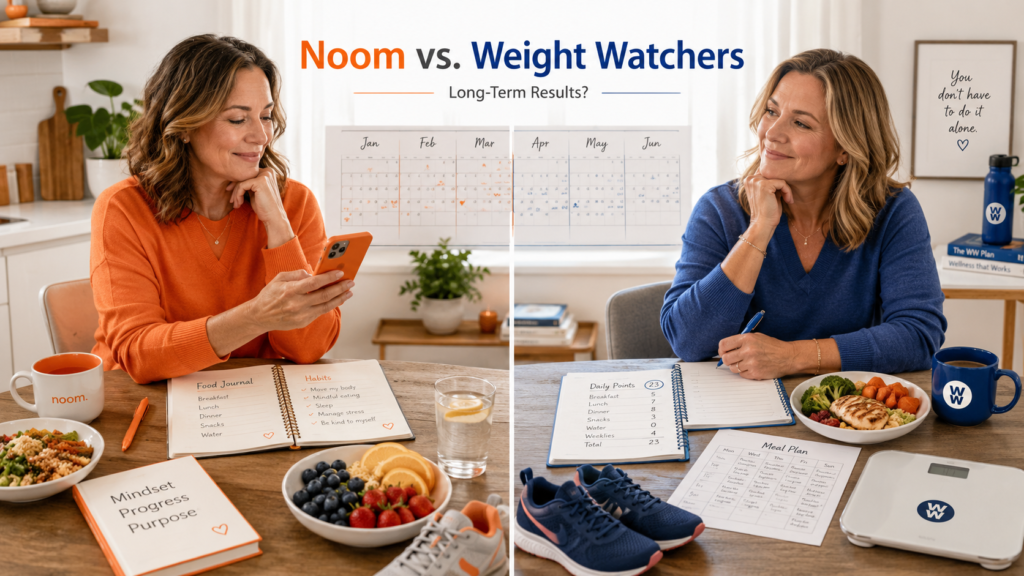
Noom rewires your brain using cognitive behavioral therapy. Weight Watchers gives you a points system and community support. Both have solid evidence, but wildly different drop-off rates researchers rarely discuss. The real question: which approach matches how you actually think about food?
At a glance:
- Noom is built on cognitive behavioral therapy (CBT) principles, designed to change how people think about food, not just what they eat.
- Weight Watchers (WW) uses a structured points system and a strong community network to simplify food decisions and keep members accountable.
- Long-term evidence exists for both, but the studies are designed differently, making a direct side-by-side comparison trickier than it looks.
- Both programs carry high drop-off rates, a limitation that the research often underreports, a critical factor addressed further below.
- The best program comes down to one question: do you need to understand why you eat the way you do, or do you need clear rules and social reinforcement to stay on track?
Two of the most popular weight loss programs on the market take fundamentally different roads to the same destination. Noom leans into psychology, while Weight Watchers leans into structure. Both work for some people and fall short for others. The question isn’t which program is objectively better. It’s which one is better wired for how you think.
One Rewires Your Brain, the Other Builds a Safety Net
Picture two people starting a weight loss journey on the same day. The first spends 10 minutes each morning reading short lessons about why stress triggers snacking, then logs their meals using a color-coded system that flags calorie density. The second person wakes up knowing they have a daily points budget, a list of zero-point foods they can eat freely, and a group meeting on Thursday night where they’ll check in with others doing the same thing.
Both people are making progress. But the mechanisms driving that progress are completely different. One is learning to rewire decision-making from the inside out. The other is working within a system designed to remove the guesswork. That’s Noom versus Weight Watchers in a nutshell, and understanding that difference is the key to choosing the right fit.
At Weight Loss Mindset, the emphasis has always been on understanding the mental side of weight loss, which makes the contrast between these two programs a particularly relevant one to unpack honestly and in depth.
How Noom Uses Psychology to Drive Change
CBT Principles at the Core
Noom’s foundation is cognitive behavioral therapy, or CBT, a well-established psychological framework that helps people identify and challenge unhealthy thought patterns. In the context of weight loss, this means Noom isn’t primarily focused on telling users what to eat. Instead, it asks why they eat the way they do in the first place.
The program builds this through daily in-app lessons, short quizzes, and self-reflection prompts. Topics range from calorie density and portion awareness to emotional eating, stress responses, and long-term habit formation. The goal is to surface the automatic behaviors and mental shortcuts that lead to overeating, and then replace them with more conscious, sustainable ones. A 2024 systematic review of studies involving Noom users found that participants using Noom for 16 weeks lost approximately 5% of their initial body weight, a clinically meaningful amount associated with health benefits. A 2021 randomized controlled trial also indicated that Noom users sustained modest weight loss at one year.
Color-Coding, Lessons, and Trigger Awareness
Rather than banning foods outright, Noom uses a color-coded system, green, yellow, and orange, to communicate calorie density and nutritional quality at a glance. Green foods (think fruits, vegetables, whole grains) are high in volume and low in calories. Orange foods are calorie-dense and typically lower in nutrients. Nothing is off-limits, but users develop an intuitive sense of proportion over time.
This color system works hand-in-hand with the curriculum. As users learn about trigger foods, emotional eating cycles, and the psychology of cravings, the food-logging experience starts to feel less like tracking and more like self-awareness practice. Users aren’t just logging calories, they’re noticing patterns. That shift in perspective is exactly what CBT-based programs aim to produce.
Built to Work After the Program Ends
One of Noom’s most compelling design goals is post-program durability. The entire curriculum is built around internalized habits, not dependence on external rules. The idea is that once someone truly understands why they reach for comfort food at 10 p.m., they don’t need an app to tell them what to do about it.
Noom also offers optional coaching, but the app-driven, self-guided experience is the core product. That distinction matters. Coaching supplements the learning, it doesn’t replace it. This architecture is intentional: the program is designed to make itself less necessary over time, which is a relatively rare design philosophy in the commercial weight loss industry.
How Weight Watchers Uses Structure to Simplify Decisions
The PersonalPoints System and ZeroPoint Foods
Weight Watchers, now officially rebranded as WW, operates on a PersonalPoints system that assigns a numerical value to foods based on nutritional factors including calories, saturated fat, sugar, and protein content. Each member receives a personalized daily points budget and a list of ZeroPoint foods they can eat freely without counting.
This design directly addresses decision fatigue. Instead of learning the nutritional science behind every meal, members follow a framework that has already done the math. ZeroPoint foods, typically lean proteins, non-starchy vegetables, and certain fruits, provide a reliable safety net. Members know that reaching for those options will never blow their budget. Over time, the system subtly steers behavior toward healthier defaults without requiring deep nutritional literacy. That structured simplicity is a significant part of WW’s enduring appeal.
Workshops, Coaching, and Community Accountability
Where Noom leans internal and self-guided, WW leans external and communal. The program offers both in-person and virtual workshops led by trained coaches, a social platform called Connect where members share progress and strategies, and tiered membership plans that unlock more personalized coaching support.
That community layer is not a minor feature, it’s central to how WW works. Peer accountability and shared experience are well-documented motivators for behavior change, and WW has built its program around them for decades. For many members, the Thursday night weigh-in or the group chat thread isn’t just a nice extra, it’s the main reason they stay on track. The structured nature of the program, combined with genuine social reinforcement, creates an environment where showing up consistently feels both rewarded and expected.
What the Evidence Actually Shows Long-Term
Noom: 4.1% Body-Weight Loss at Week 68, After the Program
Noom’s most recent randomized clinical trial produced a notable finding: participants continued losing weight for a full 52 weeks after the 16-week active program ended, finishing at an average of 4.1% body-weight loss at week 68. The control group, by contrast, showed an average gain of 1.5% over the same period. Additionally, 41% of Noom participants achieved at least 5% weight loss, compared to 19.5% of controls.
That post-program trajectory is meaningful. Most commercial weight loss programs see the opposite, weight creeping back once the active phase ends. The fact that Noom participants kept losing after completing the program suggests the behavior-change framework is producing internalized habits rather than just temporary compliance. That’s what CBT-based design, done well, is supposed to accomplish.
WW: Long-Term Maintenance Evidence and Its Limitations
WW has a longer track record of helping its most engaged members maintain meaningful weight loss over multiple years. The available long-term evidence, however, tends to focus on successful completers rather than all enrollees. Meaning the published maintenance figures reflect a self-selected, high-adherence population, not a random sample of everyone who signed up. That survivor bias is significant and worth understanding before drawing broad conclusions about WW’s average real-world outcomes.
Why These Studies Are Not a Direct Comparison
Comparing Noom and WW research directly is genuinely difficult, and not just because the numbers look different. The studies themselves are designed differently. Noom research tends to use app-based retrospective analyses and observational studies of active users, which are strong for measuring engagement but vulnerable to selection bias. WW research more often uses randomized controlled trials and long-term cohort follow-ups of successful completers, which provide stronger causal evidence but can overrepresent adherent participants.
Neither body of evidence captures the full picture of what happens to the average person who signs up, stays a few weeks, and quietly disappears. That gap in the data matters, and it’s one reason why treating either program’s headline statistics as a guaranteed outcome would be misleading.
Where Both Programs Fall Short
High Drop-Off Rates Affect Both
Despite their different approaches, Noom and WW share a common problem: high attrition. Research on commercial weight loss programs indicates that dropout rates can reach as high as 70% in some older studies. It’s worth noting that Noom’s recent randomized clinical trial reported a retention rate of 86.7% at 68 weeks among its trial participants. Though that figure reflects an engaged study population rather than all real-world sign-ups. Neither program has published clean, population-level retention data that tells the full story from initial sign-up to completion.
Noom studies tend to focus on users who remained active, which tells a strong story about engaged users but says less about the many who downloaded the app and stopped logging within weeks. WW’s long-term maintenance data, as discussed, focuses on successful completers. Both evidence streams are informative, but neither is fully transparent about how representative their headline figures are. The honest read is that both programs face substantial real-world drop-off, and the published outcomes should be understood in that context.
Noom’s Lessons Can Feel Repetitive Over Time
A recurring theme in Noom user feedback is that the daily lesson curriculum, while genuinely useful early on, can start to feel repetitive after several weeks. The CBT-based content cycles through similar themes, calorie density, emotional triggers, stress eating, and some users report that the lessons feel redundant by the time they’re a few months in. When the educational content loses its novelty, engagement tends to drop, which undermines one of Noom’s core strengths: consistent daily interaction with the program.
This isn’t a fatal flaw, but it’s a real design tension. A program built on sustained engagement needs to keep providing fresh value. For users who thrive on novelty and need ongoing intellectual stimulation to stay motivated, Noom’s content loop may eventually run thin.
Which Approach Fits You?
Choose Noom If You Want to Understand the Why
Noom is a strong fit for people who are curious about their own behavior. Those who want to understand why they reach for certain foods, how stress and emotion drive eating decisions, and how to build habits that hold up without external structure. It works best for self-directed learners who are comfortable with daily reflection and don’t need a social group to stay accountable.
It’s also a better option for people who’ve followed rigid diet rules before and eventually burned out on them. Because nothing is banned and the focus is on awareness rather than compliance, Noom tends to feel less like a diet and more like a long-term skill set. For someone who’s tired of tracking macros and counting calories with no deeper understanding of why their habits keep reverting, the psychology-first approach can be a meaningful shift.
Choose WW If You Need Clear Rules and Social Reinforcement
WW is a better fit for people who do well with defined systems. Those who prefer to know exactly what they can eat, how much room they have in a day, and what the rules are. The PersonalPoints system removes ambiguity, which is genuinely valuable for people who feel overwhelmed by open-ended nutritional choices.
It’s also the stronger choice for people who are motivated by community. If showing up to a weekly workshop, sharing progress with peers, or having a coach check in regularly keeps someone on track, WW’s infrastructure supports that far more robustly than Noom’s app-centric model. Social accountability is a powerful motivator, and for many people, it’s the difference between staying consistent and quietly falling off.
Behavior Change Outlasts Any Points Budget. Pick the Program That Matches How You’re Wired
Both Noom and WW are legitimate, evidence-supported programs. Neither is a scam, and neither is universally superior. What separates them isn’t quality. It’s philosophy. Noom tries to change the underlying decision-making process. WW tries to simplify it through structure and community. One rewires the operating system; the other builds guardrails around it.
The research backs both, with caveats. Noom has stronger evidence that its approach keeps working after the active program ends, which is rare and meaningful. WW has a longer track record of helping its most engaged members maintain meaningful weight loss over multiple years. Neither set of results applies equally to everyone who signs up, and both programs lose a significant share of users before results are ever achieved.
The most honest advice is also the most practical: pick the program that matches how you’re actually wired, not the one with the better marketing. If self-reflection and understanding the psychology of eating is what’s been missing, Noom’s approach will feel like a revelation. If clear rules and a community of people doing the same thing is what keeps someone honest, WW’s structure is hard to beat. Neither program will work if it doesn’t fit the person using it, and that fit is a personal decision, not a statistical one.
For a deeper look at the mindset side of lasting weight loss, Weight Loss Mindset covers the psychological principles that help people build habits that actually stick.
