
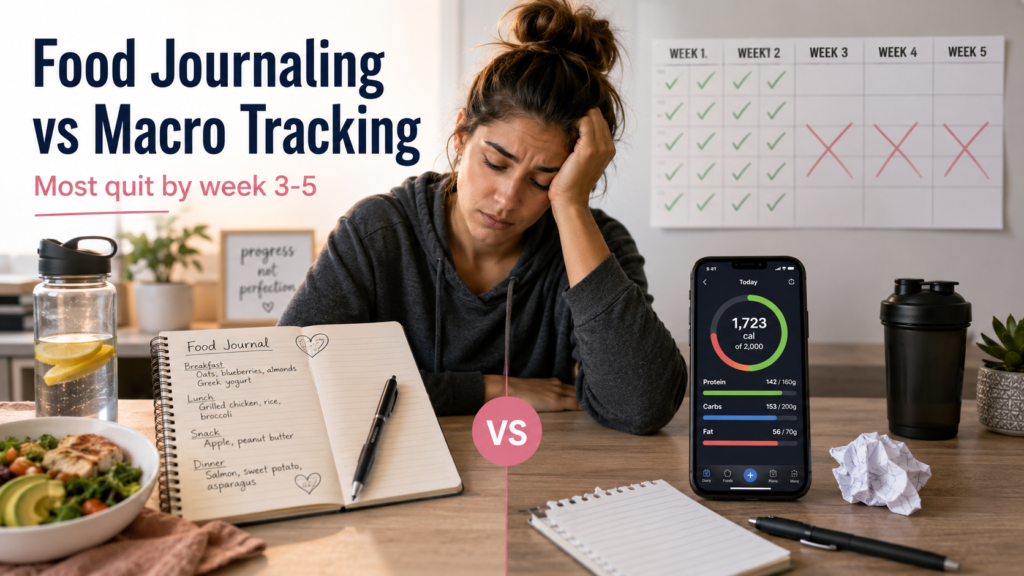
You’ve probably tried both, logging every meal or hitting your macros perfectly. But here’s what the research actually shows: 43% of people quit tracking within weeks, and the method you choose matters far less than the psychological relationship you have with it.
- Both food journaling and macro tracking are proven tools for weight loss, but the real challenge isn’t choosing between them, it’s sticking with either one long enough to see results.
- Most people quit within 3 to 5 weeks, regardless of the method, and the more effort a tool demands, the faster burnout hits.
- The psychological cost of tracking is often underestimated, macro tracking can quietly replace hunger awareness with number fixation, while food journaling can drift into something shallow or even restrictive.
- Rigid vs. flexible matters more than journaling vs. macros, the mindset brought to any tracking tool predicts the outcome far more than the tool itself does.
- There’s a deeper reason why so many people over 40 cycle through tracking methods without lasting results, and it has everything to do with what the tool is actually training the brain to do.
There’s no shortage of debate about whether food journaling or macro tracking is the “better” approach to eating well. Fitness coaches swear by macros. Therapists favor journaling. The internet has strong opinions about both. But buried in the research is a finding that reframes the entire conversation: it doesn’t much matter which method gets chosen if it gets abandoned by Week 4.
Both Methods Work. Adherence Is the Problem
Decades of behavioral weight-loss research point to the same conclusion: self-monitoring of diet works. Greater adherence to tracking eating consistently predicts greater weight loss. The act of paying attention is the active ingredient. Whether that attention is delivered through a macro-tracking app or a handwritten food journal is, in large part, a secondary question.
The second finding is just as important, and far less discussed: self-monitoring declines over time in nearly every study. Fewer than half of participants are still tracking after the later weeks in many interventions. Consistent tracking, defined as logging at least five days per week, is significantly associated with greater and sustained weight loss, but achieving that consistency is where most people fall short. The problem isn’t the tool. It’s that the tool stops getting used.
That shifts the real question. It’s not “which method is more accurate?” It’s “which kind of awareness is actually sustainable, and what does it cost psychologically to maintain it?” That second half, the psychological cost, is where food journaling and macro tracking genuinely diverge. Resources like Weight Loss Mindset are built around exactly this distinction: that the mental and emotional relationship with food matters just as much as any tracking system.
Why Quitting Happens So Fast
The 3-5 Week Drop-Off Is Well-Documented
Self-monitoring adherence, across both paper-based and app-based methods, shows a consistent pattern of decline, with research pointing to drop-offs beginning in the early weeks of an intervention. App-based tracking tells a particularly clear story: adherence to dietary self-monitoring using mobile applications declines meaningfully over a 24-week period, with engagement falling off well before the halfway point. Zoom out further, and the picture gets starker. Health app engagement data consistently shows that the vast majority of users disengage within the first month of installation, and maintaining consistent daily logging over six months remains the exception rather than the rule.
A systematic review and meta-analysis found that the pooled dropout rate for app-based health interventions, including weight management, sits at 43%, with some studies showing up to 98% of users engaging with an app for only a short time. This isn’t a niche problem or a matter of weak willpower. It’s a near-universal behavioral pattern.
More Labor = Faster Burnout
One major driver of that drop-off is simple: tracking food takes real effort. Research suggests that logging food and beverage intake in an app can take around 15 minutes per day, with one study finding that successful food loggers spent an average of 14.6 minutes daily. That’s roughly two hours per week spent searching databases, estimating portions, and reconciling numbers, before a single healthy choice is made. Over weeks, that effort compounds into behavioral fatigue.
The more labor-intensive the method, the faster people quit. Macro tracking, which requires looking up nutrient content for every meal and hitting precise daily targets for protein, carbohydrates, and fat, sits at the high end of the effort spectrum. The good news for anyone who finds tracking genuinely helpful: lower-friction tools can dramatically improve outcomes. Studies on simplified logging approaches, including AI-assisted photo recognition tools, suggest that reducing the time and effort required per entry can significantly improve adherence over 90 days, pointing to friction, not the concept of tracking itself, as a primary barrier.
What Each Method Actually Tracks
Macro Tracking: Food as Data
Macro tracking is quantitative by design. The goal is to hit daily targets for the three macronutrients, protein, carbohydrates, and fat, within a set calorie range. It emerged as a reaction against rigid diet culture, where the promise was freedom within numbers: no foods labeled as bad, just targets to meet.
A typical macro-tracking entry looks something like this:
Greek yogurt, 200g — 20g protein, 8g carbs, 4g fat. Logged. 110g protein remaining for the day.
The food becomes data. Portions, composition, and energy balance are all visible. Emotional context is invisible and structurally irrelevant to the system. That’s not a flaw exactly, it’s a design choice. But it’s a choice with real consequences for what the method can and can’t teach.
Food Journaling: Food as Context
Food journaling, particularly the food-and-mood style used in behavioral and mindset-focused approaches, is qualitative. A full journaling template typically captures: time of eating, hunger level before (on a 1-10 scale), what was eaten, thoughts and feelings before and after, location, who was present, and hunger level after eating.
The same Greek yogurt, journaled:
3:40pm. Hunger 4/10. Greek yogurt at my desk. Wasn’t really hungry — felt restless after a hard email. Ate fast, barely tasted it. Still wanted “something” after. Third time this week I’ve eaten right after a stressful message.
That second entry surfaces something the macro log structurally cannot: a trigger, a pattern, and a coping mechanism. That difference, numbers versus narrative, defines everything that follows when comparing these two methods over the long run.
The Real Psychological Cost
Macro Tracking’s Hidden Risk: Fixation Over Hunger
Done well, macro tracking builds genuine nutrition literacy. Understanding that a handful of almonds is very different from a handful of pretzels in terms of how the body uses them is genuinely useful information. For someone coming from years of vague “eating healthy” without understanding portions or protein, a few weeks of tracking macros can be an education.
But there’s an honest downside the fitness industry tends to underplay: obsessive tracking can quietly replace hunger awareness with number-chasing. When every eating decision runs through an app first, the brain gradually stops consulting the body. Hunger cues and fullness signals, the very internal tools that sustain eating well long after any app is deleted, can atrophy from disuse.
The eating disorder data is worth taking seriously, particularly for women over 40 who may have a long history with diet culture. In one clinical sample, approximately 75% of people with eating disorders used MyFitnessPal to count calories, and 73% of those users believed the app contributed to their eating disorder. A review of 38 studies found that adults using diet and fitness apps showed greater disordered-eating symptoms and more negative body-image thoughts than non-users. One important nuance: a randomized controlled trial using a low-risk sample of women with no prior tracking history found no increase in eating disorder risk after a month of app use with high adherence. The researchers’ careful conclusion was that tracking doesn’t manufacture an eating disorder from nothing, but it can accelerate one that’s already developing. For anyone with a history of fixation, guilt around food, or restricted eating, that distinction matters.
Journaling’s Weakness: Easy to Do Shallowly
Food journaling’s greatest strength is that it directly trains the skills that survive after any app or method gets abandoned. Emotional regulation. Pattern recognition. Self-trust. Writing down not just what was eaten but why, when, and how it felt builds a kind of internal literacy that no calorie counter can replicate. Anchoring journaling to daily meals also reduces the common friction of “not knowing what to write,” which helps build consistency.
The catch is that journaling produces no calorie deficit on its own and is remarkably easy to do without real depth. Listing foods without ever examining the feelings around them is technically journaling, but it captures none of the insight the method is designed to surface. It’s also not entirely without psychological risk. Practitioners working in mindset-focused nutrition caution that people with a history of heavy dieting, many food rules, or lost hunger cues may find that a journal quietly becomes a restriction diary if the mindset underneath it is already restrictive. The tool doesn’t determine the outcome, the relationship with the tool does.
Rigid vs. Flexible: The Frame That Actually Matters
The most useful distinction from the research isn’t journaling versus macros at all. It’s rigid versus flexible. Across a substantial body of research spanning decades and tens of thousands of participants, no study has found rigid dieting superior for any measured outcome. Flexible approaches, by contrast, are consistently associated with lower BMI, less eating-disorder behavior, better psychological well-being, and improved long-term adherence.
The harmful pattern researchers identified was specific: when every deviation from the plan feels like a crisis, that’s what causes harm, regardless of whether the plan is a macro spreadsheet or a journaling template. A woman can track macros flexibly and maintain a healthy relationship with food. Another can journal rigidly and spiral into obsession. The method doesn’t determine the outcome. The rigidity does.
This reframe matters because it shifts the focus away from “which tool is safer or better” and toward the question that actually predicts results: What’s the relationship with the tool? Is it a source of information, or a source of judgment? Is it a temporary teacher, or a permanent referee? That internal relationship is what separates tracking that builds lasting habits from tracking that burns out by Week 4.
The Mindset Around the Tool Predicts the Outcome, Not the Tool Itself
Here’s what the research, taken together, actually says: both methods work when used consistently, both fail when abandoned, and both carry psychological risks when used rigidly. The difference is in what each one trains over time.
Macro tracking is a powerful short-term education tool. A few deliberate weeks of it can teach portion reality and nutrition composition faster than almost any other method. But as a long-term strategy, its high daily burden and tendency to externalize food decisions make it hard to sustain, and harder still to walk away from without reverting to old habits.
Food journaling is a slower, deeper tool. It doesn’t produce a calorie deficit by itself and it can be done shallowly without much benefit. But used with genuine reflection, it builds the internal awareness and emotional regulation that outlast any app. The goal it’s working toward, becoming someone who understands their own patterns well enough to no longer need a tracking system, is a fundamentally different destination than hitting a daily macro target.
The trap many women over 40 have already lived through is using tracking as the whole strategy: white-knuckling numbers for months, burning out, quitting, and rebounding. The reframe that changes the equation is this: numbers can be a temporary teacher, but the goal is to internalize what they’re teaching. A tracking tool that builds self-awareness and then becomes unnecessary is working exactly as it should. One that creates dependency, anxiety, or shame, regardless of which kind it is, is working against the actual goal.
For people ready to move beyond the tracking cycle, Weight Loss Mindset offers mindset-focused strategies and perspectives built specifically for sustainable, lasting change.
